Les éditions David Irving Books (ex-Focal Publications) viennent d'annoncer la parution prochaine de The sundered dream, le troisième et dernier tome de Churchill's war, l'ouvrage monumental de David Irving consacré à Winston Churchill. Un ouvrage indispensable pour tous les passionnés du second conflit mondial qui maîtrisent la langue de Shakespeare...
Les ouvrages de la série peuvent être commandés sur le site de l'éditeur : David Irving Books
Historien britannique novteur, dont plusieurs ouvrages ont été traduits en français chez de grands éditeurs, David Irving est notamment l'auteur de The war path, Hitler's war et Goebbels - Mastermind of the Third Reich.
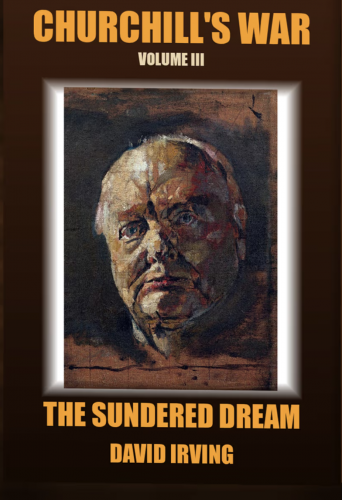
Churchill's War, Volume III: The Sundered Dream is the culmination of a biographical project that has spanned decades — David Irving's final, magisterial account of Winston Churchill's life and political career. Where Volume I covered Churchill's rise to power and the early years of the war, and Volume II traced the conflict through to its turning point, Volume III takes up the story in the final phase of the war and follows Churchill into the complex, often bitter post-war world.
This is the book that completes the picture. And what a picture it is.
The Scope
The Sundered Dream covers the period that most Churchill biographies treat as an afterthought — or skip entirely. The conventional narrative ends with VE Day and a few pages of valedictory prose. Irving's account begins where others leave off, and in doing so reveals a Churchill that few readers have encountered.
The post-war years were not kind to Churchill's dream of a lasting Anglo-American world order. The British Empire was disintegrating. The "special relationship" with Washington was fraying. The Iron Curtain was descending across Europe, vindicating Churchill's famous Fulton speech — but also exposing the limits of his influence. He had helped win the war, but the peace was being shaped by forces he could not control.
Irving traces Churchill's return to 10 Downing Street in 1951 with the same documentary precision that distinguished the earlier volumes. The private papers, Cabinet minutes, and personal correspondence of Churchill's second premiership reveal a leader grappling with declining health, a changing world, and the dawning realisation that the victory of 1945 had not delivered the future he had fought for.
The Research
The documentary foundation of The Sundered Dream is formidable. Irving has drawn on sources that were closed, embargoed, or simply unknown to other biographers at the time they wrote. These include Churchill's private secretary files from the post-war years, correspondence with Eisenhower and Truman that sheds new light on the Anglo-American relationship, and personal papers from Churchill's inner circle that capture the private man behind the public monument.
The research has been meticulous and the editing rigorous. Christina Palaia, who served as copyeditor for the volume, worked through nine batches of manuscript over many months — a painstaking process of verification, clarification, and refinement that reflects the seriousness with which Irving Books approaches the publication of a work of this importance.
The result is a volume that meets the scholarly standard set by its predecessors while covering a period of history that is, in many ways, even more relevant to the present day than the war years themselves.
What to Expect
Without giving away the revelations that make this volume so compelling, here is what readers can look forward to:
The unmaking of an empire. Churchill watched the British Empire dissolve during and after the war — a process he had spent his entire political career trying to prevent. The Sundered Dream documents this unravelling with a level of detail and emotional depth that no previous account has achieved.
The second premiership. Churchill's return to power in 1951, aged 76, is one of the most remarkable comebacks in political history. But the private record tells a more complicated story: a Prime Minister struggling with the effects of strokes, increasingly at odds with his own Cabinet, and haunted by the fear that his legacy was slipping away.
The Cold War from the inside. Churchill's post-war speeches — particularly the "Iron Curtain" address at Fulton, Missouri — shaped the Western response to Soviet expansionism. But Irving's documents reveal the private calculations behind the public rhetoric, including Churchill's surprisingly nuanced view of Stalin and his frustrated attempts to broker a summit that might have altered the course of the Cold War.
The personal cost. This is, in the end, a human story. The documents reveal a man who gave everything to his country and received, in return, both adulation and abandonment. The final chapters of Churchill's political life — his reluctant resignation, his long twilight years, and the slow fading of the extraordinary mind that had shaped the century — are rendered here with a restraint and compassion that may surprise readers who expect Irving to be merely iconoclastic.
A Note on the Series
Churchill's War is not a conventional biography. It is a documentary reconstruction — an attempt to tell Churchill's story using the same primary-source method that Irving applied to Hitler's War. The premise is simple but radical: let the documents tell the story, and let the reader draw the conclusions.
For readers who have followed the series from Volume I, The Sundered Dream delivers a deeply satisfying conclusion. For those coming to it fresh, it stands on its own as a major work of twentieth-century history — though we would recommend starting with Volume I: The Struggle for Power for the full experience.